


Uh-oh.
Today’s market can be best summed up by one theme this author heard repeatedly on various financial news reports:
“…. since 2007.”
Be it the US 10 year bond yield, the disproportionate breadth in the equity markets, the broken 5 year bond auction today (which really deserved a D-), and the unbelievably bad reports starting to emerge from the high yield credit market that was the mantra of the day in financial markets and media.
But what really has been standing out to this author is this chart when unwittingly in an effort to stiffen the upper lip, Alan Greenspan raised rates to fight inflation at the same time Secretary of the Treasury James A Baker III decided to engage in an aggressive currency skirmish with Germany and Europe. The results are as one might say, are history, as reflected by the US 10 year Treasury yield of that era.


Is this author calling for a 1987 style crash?
Not yet, but the house of cards seems to be aligning towards a major event of similar severity.
Could the market action be signaling something far worse as the President’s midterm election prospects are dimming faster than his ability to stay awake at cabinet meetings?
Perhaps, just perhaps, it is just as simple as Trump v1.0 in 2018. A relatively new Fed Chair in Jay Powell slowly beginning to raise rates in an attempt to “normalize” the cost of money back to traditional levels at the same time President Trump wanted to ramp monetary growth for his administration to brag about a super hot economy via much higher GDP while inflation was tame.
What was amazing to see was the parallel of oil pushing prices slightly higher and rising proportionately with stocks in that time period:


Is it really that simple?
The Democrats had seized control of the House of Representatives but overall the damage was contained thanks the Republicans gaining two more seats in the Senate. Unfortunately for President Trump all that did was amplify the circus and paralyze any policy initiatives as the Covid pandemic would change the economic landscape for the United States just two years later.
These pages do not think it is that simple, although the 2018 Christmas Crash is indicative of a period of strong economic growth with great credit and liquidity risk coming to the forefront when one least expects it.
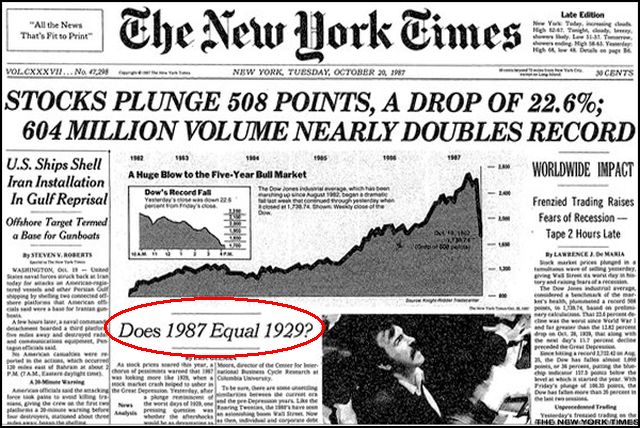
The 1987 era however has many of the same identifying markers however, that we are witnessing today. For a point of comparison, let us look at this article by Anise C. Wallace in the October 11, 1987 New York Times and pinpoint the parallels and differences today. I shall do so by highlighting points from Wallace’s article versus this time period.


-Overvalued but not overpriced equities (as perceived by Wall Street metrics and media) and once again, using the Artificial Intelligence pump, the same mantra is being promoted.
-Uninterrupted economic growth. 59 months in 1987. In this era, 17 months since the negative print of 2025, but 51 months since two consecutive negative back-to-back GDP prints for the undeclared Biden recession.
-During that era it was rightfully proposed that peace with the USSR was happening. In this era it is peace in the Middle East from an unwise conflict in addition to a soothing of relations with China, or at least an attempt to do so.
-Continuous buying of stocks by international investors. Think about that statement from 1987 and look at our markets today exposed to buying from not just Japanese investors, but sovereign wealth funds in the Middle East and of course, Europe.
-“The strong underpinning for the 100 largest-capitalized stocks.” That was actually the theory in 1987 in conjunction with Asian buying. Unfortunately it ignored the rot underneath the surface, especially in the abusive use of speculation via options and derivatives, much like the media is refusing to cover in detail for over a year now.
The article turned into an unfortunate marker for the week which would follow and the abject terror which hit Wall Street and Main Street as visions of 1929 danced through the minds of traders and retirees alike.
Does the US look similar to that era as far as arrogance and ignorance?
Unfortunately, yes.
The Dow was up 44% year to date before the crash of 1987. What is terrifying by comparison is that since 2022 and the lows of 2023, the S&P 500, a much broader and more appropriate measure of equities today is now up over 73%.
The United States became a massive believer in the concept of “portfolio insurance” to prevent a sudden liquidation event or crash.
Today, the Gods of Artificial Intelligence and algorithms have promised our financial overlords stability and no possible way a severe event could occur like the past; despite the same group of arrogant geeks never exactly explaining why so many flash crashes in indexes, commodities, or individual equities for no apparent reason.
Lastly, the belief that the Federal Reserve always knows best has yet to be tested like Greenspan in 87, 98, and 01. Or Bernanke from 2007 to 2012 and Powell in 2018 and 2020. Kevin Warsh just wanted to be left alone to do his thing and “normalize” rates to what the economic gurus think the cost of money should be; even thought the economic regime of what is “normal” has changed dramatically in the past forty years.
In 1987 the smart money gave warnings but no one listened after the crash and happened with the Savings and Loan crisis followed by a major recession after Gulf War I was easy to project if one followed the bond market.

After the crash of 1987, the S&L crisis plus post war reaction to a short period of skyrocketing oil prices was exacerbated to the point where economic instability of persistently higher prices led to an inversion of the 2s and 10s. This was followed by a parallel decline in both long and short term rates leading into the late 1990 recession. Weirdly enough, the recession occurred on the precipice of the personal computer and internet technological revolution of the 1990s; just as economic uncertainty and instability now is at the doorstep of the AI and robotics revolution.
Is THIS the Big One?
It truly is too hard to tell at this point. If an event were to occur leading to a massive market decline the circuit breakers at 20% would stem the fall and probably close the markets for a day. But would that stem a perfect Fibonacci retracement or correction of 38% or more? Unfortunately unlike 1987, no matter the course of action of the Federal Reserve, political reality indicates the Trump administration could potentially suspend trading until after the midterm elections should a major stock market crash occur in the next 40 days.
Such a reaction would definitely introduce massive instability into the US economy and worse, all of the liquidations and trading in the dark pools or off market trades (which account for over 50% of all equity activity) would eventually be reflected in the public arena when the major exchanges reopened. This is an outcome the gurus of greed never considered as a possibility that private off market action in equities and derivatives would eventually expose the public to such dramatic leveraged risk outcomes.
Personally speaking, the conditions of the economy, the markets, and political instability are not, I repeat NOT identical to 1987 or 2018.
Because this time it is different, and the outcomes will probably be substantially worse.