


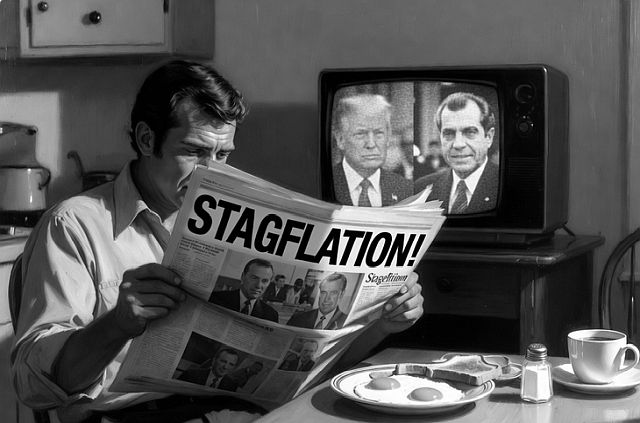
As the world turns, these are the days of our lives.
Tomorrow, the Federal Reserve’s FOMC will release their latest decision and dogs will sleep with cats, the Hudson River will part so cockroaches can leave their rent restricted tenements to flee to New Jersey, and CNBC will have hosts hyperventilating live on television because they can’t scream “look at me” and ask Fed Chariman Kevin Warsh a stupid question about his hair gel.
Or the aliens will eat all of us or something.
In reality the American people are going to be told in 200 words or less that inflation sucks so deal with it until the various task forces provide their reports after leaking them to the big banks, so for now the Fed can’t do a thing. Now that I’m through stating the usual vitriol and disgust for where our media, society, and central bank is at, let’s review a little history and see just what could happen tomorrow that will cause a stir before Wall Street CEOs take their final Hamptons vacation.
I. The 30-40% Fed Funds Rate Increase Possibility
This week’s preview of the FOMC meeting was shaken up by this bit of news from Bloomberg (via YahooFinance):
Citadel Securities Sees Warsh Delivering Surprise Fed Rate Hike
The call for a 25 bps increase seemed to cause some traders to stop and think but in reality would that be that bad? Historically, one would say a resounding “YES!“
How so? Let’s review a brief history of surprise or so-called shock rate increases since the Federal Reserve’s inception.
A. August 9, 1929 – Federal Reserve Bank of New York Increases the Discount Rate from 5% to 6%
From the August 10, 1929 New York Times article on the rate increase:
Governor YOUNG of the Federal Reserve Board explained its action in permitting the Federal Reserve Bank of New York to raise the discount rate to 6 per cent as due to a desire to “conserve the resources of the Federal Reserve System” and to make them “available to meet Autumn requirements.” These are sound reasons. They fit perfectly the purposes of the act creating the Federal Reserve Bank.
B. September 7, 1973 – Burns Inflationary Bear Move
From August 1972 to September 1973, the FOMC increased rates by approximately 50 bps per month culminating with an increase in September 1973 which brought the effective Fed Funds Rate to almost 10.80%. In the statement of September 18, 1973 from the Federal Reserve below, the inflationary pressures were highlighted in this decision:


C. Greenspan Knows All, Until He Didn’t
The economy was booming. Personal computers were a hit, the dollar wavered but was stronger, and a younger version of Alan Greenspan thought he knew how to solve the inflation issue without damaging the economic prospects of the United States moving forward. Thus in the September 22, 1987 FOMC Statement, the following course of action was initiated:


D. Powell’s First Folly in 2018
On December 18, 2018, the FOMC initiated a Fed Funds Rate increase of 25 bps where the statement said:
Consistent with its statutory mandate, the Committee seeks to foster maximum employment and price stability. The Committee judges that some further gradual increases in the target range for the federal funds rate will be consistent with sustained expansion of economic activity, strong labor market conditions, and inflation near the Committee’s symmetric 2 percent objective over the medium term. The Committee judges that risks to the economic outlook are roughly balanced, but will continue to monitor global economic and financial developments and assess their implications for the economic outlook.
In view of realized and expected labor market conditions and inflation, the Committee decided to raise the target range for the federal funds rate to 2-1/4 to 2‑1/2 percent.
Of course after the disaster by Christmas Eve and the Fed’s attempts to shoot down Santa Claus with deflationary anti-sleigh missiles, this policy was reversed somewhat quickly on Christmas Day of that year.
E. Powell’s Second Folly in 2022
The July 15, 2022 FOMC meeting was nothing less than a teaser for the fireworks to come. The statement again highlighted the inflationary problem:
The Committee seeks to achieve maximum employment and inflation at the rate of 2 percent over the longer run. In support of these goals, the Committee decided to raise the target range for the federal funds rate to 1‑1/2 to 1-3/4 percent and anticipates that ongoing increases in the target range will be appropriate. In addition, the Committee will continue reducing its holdings of Treasury securities and agency debt and agency mortgage-backed securities, as described in the Plans for Reducing the Size of the Federal Reserve’s Balance Sheet that were issued in May. The Committee is strongly committed to returning inflation to its 2 percent objective.
II. Actions Have Consequences as History Reminds Us
Needless to say the 1929 policy action does not need a rejoinder of what occurred. However, the 1973-1975 stagflationary recession does remind many of us “old folks” of the policy mistakes we have all witnessed in the last ten years. To say that it did not would be a lie as even the Federal Reserve in Kansas City published a research paper on July 1, 2022 titled “Inflation in 1972: A Cautionary Tale” where this chart was one of this author’s favorite highlights:


Of course most people want to dismiss the stagflation scenario because that was during the primitive 1970’s where we had a war no one wanted and a corrupt President creating economic and domestic turmoil with his actions. There’s no way the United States could repeat that again; but I digress.
The supremely confident “I know I’m right” Alan Greenspan of Housing Bubble, LTCM, and other fame thought during his first meetings in 1987 he knew what was good for the market and how to manage inflation. October of 1987 taught Mr. Greenspan a harsh lesson shortly after the FOMC’s course of action in September:


Is this author predicting a 1987 style crash as a result of this FOMC meeting?
It’s in the range of possibilities, but let’s look past the GFC to more recent history.
In 2018, a major financial crisis was brewing in the financial system and Jay Powell was thrown to the wolves to sink or swim. Inflation and “normalization” of rates after Bernanke and Yellen’s QE giveaway to bailout the banks at the expense of Main Street had left America with almost eight full years of anemic growth but thankfully little inflation. When Powell’s FOMC attempted to raise rates in December of 2018 it was in the midst of a liquidity crisis were several major banks were rumored to be in deep trouble with leftover garbage from the 08 crisis.
Markets were crashing and after the Fed Funds rate increase, panic basically ensued from the day after the Fed meeting until Christmas Day and the alleged Dudley leak via Medley Global Advisors led to a turnaround in markets with the Dow registering its largest one day rally in history at that time.
Fast forward to 2022 in the midst of an inflationary market decline where stagflation was the concern of the day and the July Fed meeting with a 25 bps rate increase. Powell’s Second Folly led to a brief rebound rally in equities only to be followed by a further decline into the fourth quarter as inflation still was not contained and showed no signs of abating despite all of the browbeating by Fed speakers.
III. Young, Burns, Greenspan, OR?
The possibilities seem endless but this author takes Chair Warsh at his word when he says he wants to be more like Alan Greenspan. Thus the odds of a rate increase tomorrow are probably still less than 30% in my opinion. The more realistic approach, especially considering the problems in Japan with the Bank of Japan policy decision to be issued after the FOMC is that another hawkish hold will be announced with “concerns” over the sticky inflation persisting.
By initiating the “task force” concept, Warsh has bought himself the time he needs to formulate his own path and policy which this author believes will be unveiled at Jackson Hole where his next truly public policy statement will occur. The equity markets should rally into the remaining earnings on this news up until Nvidia’s earnings at the end of August and before his speech on August 28th. That provides the Fed Chair cover should there be a negative reaction as much of Wall Street will already be on vacation for the Labor Day holiday. This of course provides more time for the Fed to review the task force recommendations and determine what to course of action to take at very much live September FOMC meeting.