


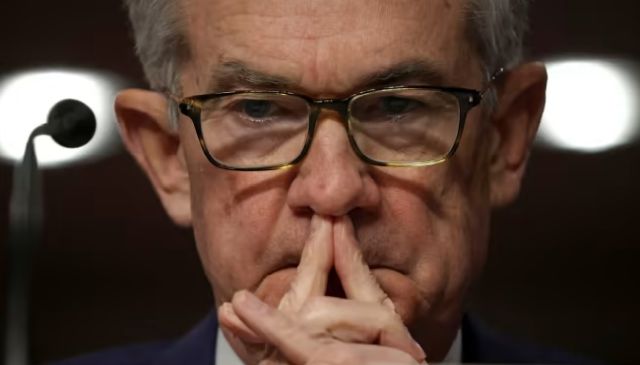
Parting is such sweet sorrow.
And with those words I bid adieu to Federal Reserve Chairman Jerome (“Jay”) Powell who held what should be his final presser in that role.
There is no point in reviewing what he said but let’s take a moment to look at the final FOMC meeting with the statement published today:
April 29, 2026
Federal Reserve issues FOMC statement
Recent indicators suggest that economic activity has been expanding at a solid pace. Job gains have remained low, on average, and the unemployment rate has been little changed in recent months. Inflation is elevated, in part reflecting the recent increase in global energy prices.
The Committee seeks to achieve maximum employment and inflation at the rate of 2 percent over the longer run. Developments in the Middle East are contributing to a high level of uncertainty about the economic outlook. The Committee is attentive to the risks to both sides of its dual mandate.
In support of its goals, the Committee decided to maintain the target range for the federal funds rate at 3‑1/2 to 3‑3/4 percent. In considering the extent and timing of additional adjustments to the target range for the federal funds rate, the Committee will carefully assess incoming data, the evolving outlook, and the balance of risks. The Committee is strongly committed to supporting maximum employment and returning inflation to its 2 percent objective.
In assessing the appropriate stance of monetary policy, the Committee will continue to monitor the implications of incoming information for the economic outlook. The Committee would be prepared to adjust the stance of monetary policy as appropriate if risks emerge that could impede the attainment of the Committee’s goals. The Committee’s assessments will take into account a wide range of information, including readings on labor market conditions, inflation pressures and inflation expectations, and financial and international developments.
Voting for the monetary policy action were Jerome H. Powell, Chair; John C. Williams, Vice Chair; Michael S. Barr; Michelle W. Bowman; Lisa D. Cook; Philip N. Jefferson; Anna Paulson; and Christopher J. Waller. Voting against this action were Stephen I. Miran, who preferred to lower the target range for the federal funds rate by 1/4 percentage point at this meeting; and Beth M. Hammack, Neel Kashkari, and Lorie K. Logan, who supported maintaining the target range for the federal funds rate but did not support inclusion of an easing bias in the statement at this time.
So why is this important?
Let’s review a more valid measure of where interest rates should be if America had actual free markets and let them set the cost of money to the financial system.


For the question my readers might have now, why does this author call this the “end of an error” and not era?
Fed History
Let’s review from the current era via the Federal Reserve’s own biography pages, the recent Fed Chairs.
I. Jerome Powell – The Yes Man
Jay Powell’s bio speaks volumes as to why he was selected to become the Chair:
Jerome H. Powell first took office as Chair of the Board of Governors of the Federal Reserve System on February 5, 2018, for a four-year term. He was reappointed to the office and sworn in for a second four-year term on May 23, 2022. Mr. Powell also serves as Chairman of the Federal Open Market Committee, the System’s principal monetary policymaking body. Mr. Powell has served as a member of the Board of Governors since taking office on May 25, 2012, to fill an unexpired term. He was reappointed to the Board and sworn in on June 16, 2014, for a term ending January 31, 2028.
Prior to his appointment to the Board, Mr. Powell was a visiting scholar at the Bipartisan Policy Center in Washington, D.C., where he focused on federal and state fiscal issues. From 1997 through 2005, Mr. Powell was a partner at The Carlyle Group.
Mr. Powell served as an Assistant Secretary and as Under Secretary of the U.S. Department of the Treasury under President George H.W. Bush, with responsibility for policy on financial institutions, the Treasury debt market, and related areas. Prior to joining the Bush administration, Mr. Powell worked as a lawyer and investment banker in New York City.
In addition to service on corporate boards, he has served on the boards of charitable and educational institutions, including the Bendheim Center for Finance at Princeton University and the Nature Conservancy of Washington, D.C., and Maryland.
Mr. Powell was born in February 1953 in Washington, D.C. He received an AB in politics from Princeton University in 1975 and earned a law degree from Georgetown University in 1979. While at Georgetown, he was editor-in-chief of the Georgetown Law Journal.
At no point does this biography indicate economist nor serious banking experience beyond being a hired gun for Carlyle and “a lawyer and investment banker in New York City” yet people lauded President Trump’s choice of him as FOMC chair in his first administration.
Mr. Powell’s ability as an attorney however is not in question. After all of these years, one can not doubt his ability to twist himself into a pretzel to accommodate the financial institutions he serves while at the same time tinkering with economic policies which inflicted benefits to wealthiest in American society and politics while attempting to inflate away the mistakes of previous Federal Reserve policymakers.
Yet when real trouble hit, his lack of macroeconomic perception cost not the bankers, nay, it cost the American economy by indicating his preference to save the big banks and screw the little guy. Do we need a reminder of what happened during the Christmas holidays of 2018?


Some major financial institutions were in trouble so the solution? Renege on controlling inflation as promised by the Fed and secretly bail them out after the market close on Christmas Eve of 2018 by leaking the information to the big banks and creating a historic rally which killed the “free” marketeers and exposed that the system since 2009 was forever under the control of the central bank and too big to fail institutions.
Of course during Covid, Powell doubled down to make matters worse lighting the fuse on another historic housing bubble and inflationary cycle which America has yet to recover from, and in all likelihood due to his poor timing and macroeconomic illiteracy, never will.
II. Janet Yellen –The Fixer
From the same Federal Reserve History pages:
Janet L. Yellen took office as chair of the Board of Governors of the Federal Reserve System in February 2014, for a four-year term ending February 3, 2018. She was succeeded by Jerome Powell.
Yellen graduated summa cum laude from Brown University with a degree in economics in 1967. She received her doctorate in economics from Yale University in 1971. From 1971 to 1976, she was an assistant professor at Harvard University. From 1977 to 1978, she worked for the Board of Governors as an economist, before joining the faculty of the London School of Economics and Political Science (1978-80).
Yellen is professor emeritus at the University of California at Berkeley, where she has been a faculty member since 1980. During her time there, she was also the Eugene E. and Catherine M. Trefethen Professor of Business and Professor of Economics.
Yellen took leave from Berkeley for five years starting in August 1994. She served as a member of the Board of Governors until February 1997 and then left the Board to become chair of the Council of Economic Advisers through August 1999. She also chaired the Economic Policy Committee of the Organization for Economic Cooperation and Development from 1997 to 1999. Yellen served as president and chief executive officer of the Federal Reserve Bank of San Francisco (2004-10) as well as vice chair of the Board of Governors (2010-14) before her appointment as chair.
Yellen is a member of both the Council on Foreign Relations and the American Academy of Arts and Sciences. She has served as president of the Western Economic Association, vice president of the American Economic Association, and a fellow of the Yale Corporation.
She has received a number of academic honors during her career. These include the Wilbur Cross Medal from Yale in 1997, an honorary doctor of laws degree from Brown in 1998, and an honorary doctor of humane letters from Bard College in 2000.
Yellen has written on a wide variety of macroeconomic issues, while specializing in the causes, mechanisms, and implications of unemployment.
The emphasis is mine. Why?
Her job was to maintain political, not economic stability while she was Federal Reserve Chair. But if one takes a look into her statements during the Great Financial Crisis one would realize she was as ignorant as the orange fiend who was CEO of Countrywide as it imploded.
Two excerpts from her speech on the economy in 2007 via the Federal Reserve website speak volumes to her incompetence during that era:
This development suggests that the process of resolving the imbalances between demand and supply in the housing market may be underway, and, as a result, we could very well see the drag on real GDP from housing construction wane later this year.
How did that work out? But wait, let’s not take this individual installed by Obama to promote 1% GDP growth as 3%+ out of context. Nay, let’s look at more from that speech:
Up to this point, we haven’t seen signs of such spillovers. Consumption spending has been well maintained, showing a robust growth rate for all of 2006. However, going forward, there are at least a couple of ways that spillovers from weakness in housing could depress consumer spending, and these channels bear watching. First, housing makes up a significant fraction of many people’s wealth, so a significant change in house values can affect consumer wealth and therefore consumer spending. As you know, there have been fears about plummeting house prices. But so far, at least, house prices at the national level either have continued to appreciate, though at a much more moderate rate, or have fallen moderately, depending on the price index you look at. Looking ahead, futures markets are expecting small declines in a number of metropolitan areas this year. While these modest movements are undoubtedly imparting less impetus to consumer spending now than during the years of rapid run-ups, their effects are not likely to be dramatic.
Again, emphasis is this author’s.
So how did her statement about “their effects are not likely to be dramatic” work out?
Just the greatest financial crisis in history and a willingness to attempt a rewrite of this period to protect the most powerful in American society.
III. Ben Bernanke – The Great Denier
Ben Bernanke came into the Chairmanship as an acolyte from the Greenspan academic tree of leadership.
From the Fed website:
Bernanke was born in Augusta, Georgia, and grew up in Dillon, South Carolina. He received a bachelor’s degree in economics in 1975 from Harvard University (summa cum laude) and a doctorate in economics in 1979 from the Massachusetts Institute of Technology.
Bernanke was an assistant professor of economics at the Graduate School of Business at Stanford University from 1979 to 1983 and associate professor of economics there from 1983 to 1985. His teaching career also included serving as a visiting professor of economics at New York University (1993) and at Massachusetts Institute of Technology (1989-90).
Beginning in 1985, Bernanke was a professor of economics and public affairs at Princeton University. From 1994 to 1996, Bernanke was the Class of 1926 Professor of Economics and Public Affairs at the university and was then the Howard Harrison and Gabrielle Snyder Beck Professor of Economics and Public Affairs and chair of the Economics Department at the university from 1996 to 2002 before becoming a member of the Board of Governors.
Over the years, Bernanke has served the Federal Reserve System in several roles. He was a member of the Board of Governors from 2002 to 2005; a visiting scholar at the Federal Reserve Banks of Philadelphia (1987-89), Boston (1989-90), and New York (1990-91, 1994-96); and a member of the Academic Advisory Panel at the New York Fed (1990-2002).
Before his appointment as chairman of the Board of Governors, Bernanke was chairman of the President’s Council of Economic Advisers, from June 2005 to January 2006.
No experience in banking, just like Janet Yellen, but a great theoretical understanding of economics.
That worked out great until Alan Greenspan took a dump in his coffee cup in 2007 and said “kid you’re on your own” allegedly.
The reality is that Bernanke’s economic hypothesis was based on stable, rational economic behavior. The concept of dynamic economic changes in consumer behavior validated by an immoral desire to obtain goods, services, and wealth outside of the norms would lead to irrational outcomes set him up for failure.
As “they” say, the rest is history.
IV. Alan Greenspan – The Enabler
The great royalty and savior of financial markets in 1987, 1998, and 2002 is viewed by the financial elites as one of the great recent Federal Reserve Chairs next to Paul Volcker. In reality he shifted his Rand like views from reality to political expediency to maintain power after LTCM in 1998 and worse, with the great free money run which stimulated the housing bubble after 2002.
The Greenspan chairmanship is best noted for his enabling of the concept called “moral hazard.” Sir Alan’s actions were the basis for the idea of socializing losses which of course put the masses on the hook for the gambling addiction Wall Street and Washington still suffer from to this day.
He can not be totally blamed for this as in 1998 and 2002 the political pressure to bail everyone out with easy money was tremendous. But when one reviews the consequences of his leadership and actions, there is no escaping that his politicization of the Fed is how the American system ended up where it is today.
Conclusion
The reality is that Jay Powell’s selection was the lazy choice in 2017, inspired by President Trump’s first term where any appointment win was considered a major victory. Yet Powell’s lack of macroeconomic comprehension from 2018 forward has led to an embedded inflation which has crushed and created the lower leg of the so-called ‘K’ shaped economy leading to economic distortions which will reverberate for decades.
The incoming Chairman Kevin Warsh, is no more than a lackey for the large institutions and the power players in Washington, DC. Historians will write, long after this author is gone, that he is nothing more than a modern day version of Benjamin Strong; an enabler for more economic and financial malfeasance.
While the left cries about his Wall Street influence, that will fade once they re-attain power, allowing their influence to expand and distort the economic future even further.
Got gold?