


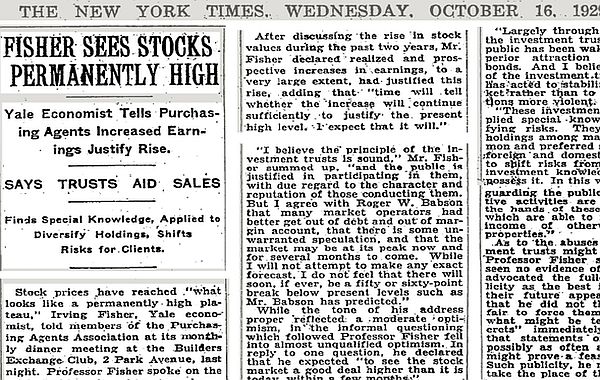
September 3, 1929.
The Dow Jones Industrial Average reaches an all time high. And not too long after that, everything else became history in a very unfortunate way.
September 4, 2007.
The CNBC headline said it all:
Wall Street Bullish on September Stocks, According to CNBC’s Exclusive Trillion Dollar Survey
Of course looking at the past, one can not help but reflect on the present.
September 2, 2026.
From CNBC‘s interview of Commerce Secretary Howard Lutnick:
Rates should ‘stabilize and start to decline’ over the coming months, Lutnick says
Commerce Secretary Howard Lutnick doesn’t believe the recent rise in Treasury yields is anything to be concerned about.
In an interview with CNBC’s “Squawk Box” on Wednesday, Lutnick said he thinks that a pickup in the growth rate of the U.S. economy, as well as a reduction in the deficit — which reached its highest monthly level in more than five years in July — will ultimately “bring rates down.”
“I’m comfortable with where things are,” he said. “I think what you’ll see is rates stabilize and start to decline over the coming, let’s say, six months.”
It’s not the arrogance of the Irving Fischers, the Bull Tossing pumper, or other infamous equity promoters before every period of stormy water. The problems are foundational, as notated in the belief that the US economy when performing at its highest levels can never head into the final quarter of the year with a crisis that destroys investments across the board; destroys all but the safest physical investments which become the ultimate hedge that is.
For example in December of 2007 the GDP talk about the third quarter was massively promoted as an indication the problems in the finance and real estate sectors were somewhat isolate and would not impact the larger economy. The economist Diane Swonk offered her opinion of the economy during the Chicago Federal Reserve Economic Outlook Symposium: Summary of 2007 results and forecasts for 2008:
Diane Swonk, Mesirow Financial, delivered her outlook for the banking, housing, and investment sectors. She argued that the financial turmoil of recent months created a compression of the housing slowdown, which she forecasted to bottom out in the second half of 2008.
That excerpt in hindsight was quite painful when one reflects on what happened, unfortunately this quote from the same event did not hold up so well either:
In terms of financial markets, Swonk characterized the current situation as a “crisis of confidence” and not a “liquidity crisis.” According to Swonk, effective liquidity provision and risk management appear to be the main concerns for investors with sufficient liquidity who are waiting on the sidelines; they are poised to reenter the market once confidence is restored.
Months later the depths of the “liquidity crisis would appear. But how did Q3 peform in 2007 before the crash?
From the Bureau of Economic Analysis webpage December 20, 2007 just weeks after the actual Great Financial Crisis recession began:
Real gross domestic product — the output of goods and services produced by labor and property located in the United States — increased at an annual rate of 4.9 percent in the third quarter of 2007, according to final estimates released by the Bureau of Economic Analysis. In the second quarter, real GDP increased 3.8 percent.
Wait, what? But that was then, what about now? Here is the latest from the Atlanta Federal Reserve’s GDPNow webpage:


These pages only like to recite history because of its beautiful rhyme and reason. For some strange reason the first week or two of September seems to provide excess hope and dreams for the markets, the media, and the political elites when the entire foundation the celebratory structure is built upon is nothing more than a termite ridden framework of balsa wood.
Prepare accordingly and one has to ask themselves, do I own enough gold?