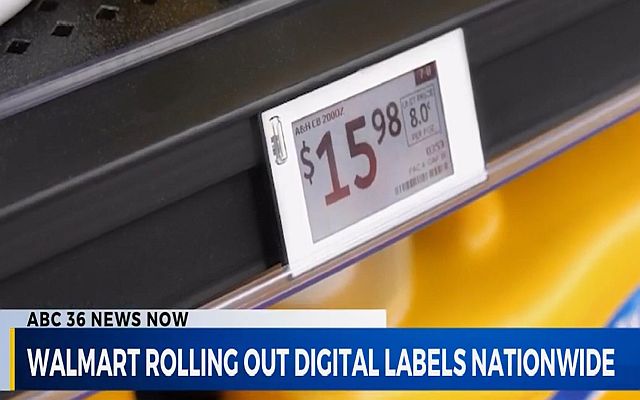
While these pages were busy recovering from surgery, a story broke about Walmart initiating a change of its price labeling system from “paper” to digital. This video from ABC-36 WTVQ is a sample of what was rolled out to little concern:
While this might seem innocuous enough as Kohl’s has had this system in place for years to offer “flash” discounts to customers, this was before the era of commodity shortages, rapid inflationary surges, and economic instability that has happened long since that was the norm.
Is this something new?
No, not really but now that it has appeared in stores, the story gets media coverage. It actually was announced via Walmart’s website on June 6, 2024:
New Tech, Better Outcomes: Digital Shelf Labels Are a Win for Customers and Associates
The Walmart website put the happy face, of course, on the move:
Now, I’m excited to announce we’re expanding this new technology, called digital shelf labels (DSLs), to 2,300 stores by 2026.
This represents a significant shift in how I, and other store associates, manage pricing, inventory, order fulfillment and customer interactions, ensuring our customers enjoy an even better shopping experience.
Is it however a “better shopping experience” in an era of instability and higher commodity inflation which fluctuates week to week?
The experience from the Weimar era is a resounding “no” but obviously the US is never going to go full Zimbabwe.
But just what could a tool like this be used for to contain the imputed feelings of inflation and its consequences for the consumer?
Since President Nixon took this for a test drive in the 1970’s, let’s review his course of action which shocked the world when Paul Volcker, Connolly, and Nixon announced their inflation containment policy.

While this price control shock was not seen as radical in 1971, the truth is such an action would have a massive impact on the US Treasury market in this current time regime as the disruptions could well impact far beyond consumer purchasing power and into the desirability of owning much less trusting US sovereign debt.
So what does this all have to do with Walmart?
This is NOT an article attacking an American corporation that has brought affordable prices to 21% of the US grocery market.
It is however a warning. IF the government, say one more corrupt than the current administration took power, and ordered price controls and dynamic pricing enforcement on all primary consumer goods such a system could not only be imposed to enforced immediately with little thought to the corporation’s margins or consumer’s ability to afford goods under such a system.
Thus my warning boys and girls:
Worry less about hyperinflation and more about wage and price controls as the command control corporatism economic system is further implemented in the months and years ahead.