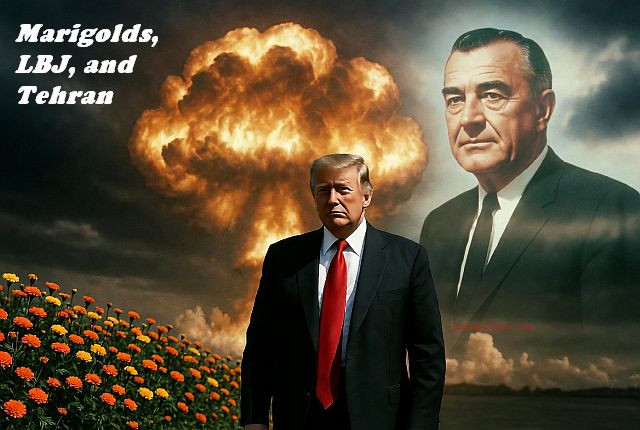
The number of Americans who have a clue about this title probably is under 100 out of 350 million.
What the hell does a common garden flower, an egotistical maniac President, and the capital of Iran have to do with anything then or now?
Everything, as history is one’s guide to understanding the present.
I. The Current Situation
As of tonight, Trump has rejected the super secret Iranian position that has been leaked all over social media then imposed new demands on the regime in Tehran. Of course, none of the demands that Trump presented are acceptable nor are the new sanctions against any nation or entity paying the ‘environmental toll’ that Iran imposed so basically the ceasefire is status quo. Unless of course one is an IRGC missile crew being killed by “defensive” US military strikes or a US soldier killed or wounded in Kuwait after an Iranian missile strike.
If any of this seems redundant it should.
The Persians have survived being conquered by Alexander the Great, defeating the Roman Empire in battle, the Sunni attempt to extinguish the Shi’ite Sect and rewrite the history of Ali, Genghis Khan’s genocidal destruction, and a period under the British Empire.
For some reason I do not think another US President who is only interested in his own personal economic glory intimidates nor will force Tehran into a rushed agreement to satisfy Trump’s poll numbers before the midterm elections.
This brings the entire point of this analysis back to history, a point in time where an arrogant ass as a US President thought he could intimidate what he perceived as a third world power that should have been vanquished under colonial ru
II. How a Common Garden Flower Can Teach Everyone About the Iran-US War

The simplistic beauty of the Marigold. Easy to grow most of the time, easy to maintain, and having absolutely nothing to do with the alleged negotiations via Pakistan between the US and Iran.
Unless one starts to open a history book and review the history of Operation Marigold, a peace negotiation which realistically could have ended the Vietnam War in 1966 and then draw the parallels to what happens when the Generals who were warmongers along with a President whose arrogance created a false bravado which would be exposed by 1968.
The North Vietnamese Premier Pham Van Dong made the first proposal to push for a ceasefire with a return to the conditions of the 1954 Geneva Accords plus the following four demands:
1. Recognition of the basic national rights of the Vietnamese people – peace, independence, sovereignty, unity, and territorial integrity… The U.S. government must withdraw from South Vietnam U.S. troops, military personnel, and weapons of all kinds, dismantle all U.S. military bases there, and cancel its military alliance with South Vietnam. It must end its policy of intervention and aggression in South Vietnam…
2. Pending the peaceful reunification of Vietnam, while Vietnam is still temporarily divided into two zones, the military provisions of the 1954 Geneva agreements on Vietnam must be strictly respected…
3. The internal affairs of South Vietnam must be settled by the South Vietnamese people themselves, in accordance with the program of the NLF, without any foreign interference.
4. The peaceful reunification of Vietnam is to be settled by the Vietnamese people in both zones, without any foreign interference.
Sound familiar?
So where does “Operation Marigold” come into all this?
The New York Times on February 3, 1966 published a story about the proposed peace negotiations from North Vietnam with this key excerpt:
In the view of United States officials, acceptance of Hanoi’s terms would mean surrender to the Vietcong in South Vietnam and agreement to eventual unification of Vietnam under Hanoi’s control.
The negotiations were top secret as the US intelligence community believed that the initiative was the work of the Eastern Bloc nation of Poland facilitating false negotiations on behalf of the USSR to embarrass the US militarily in Vietnam. In the end, as discussed by Wallace J. Thies, in When Governments Collide: Coercion and Diplomacy in the Vietnam Conflict, 1964-1968, the truth might even be more painful:
Perhaps the most thorough scholarly analysis of all the secret diplomatic probing efforts during this period to open Vietnam peace talks, written after the declassification of a substantial portion of the U.S. record, concluded in 1980 that, “With the benefit of hindsight, it appears that the MARIGOLD contact offered the best opportunity for the Johnson Administration to negotiate a settlement of the conflict.”
Many of the details of these negotiations were still denied by LBJ after he left office, as the blunders committed by his administration lead to an increase in US involvement, more unnecessary deaths on both sides, and worse for the Democrats in power at the time, a massive power shift to their mortal enemy Richard Nixon and the Republican Party of that era.
Does this sound familiar?
Over this past weekend it was believed a serious negotiation was underway once again using the intermediaries in Oman and Pakistan to codify the ceasefire and begin the de-escalation phase of the conflict. Suddenly, on May 30th, Trump once again changes his mind (or had a third party convince him) that it’s time to take a harder line with Iran and he posted this nonsense on his dying social media platform:

The unique position of strength North Vietnam attempted to negotiate from parallels the positions Tehran has adopted now. Both nations were then, and are now, technologically inferior to the United States yet displayed strategic defiance knowing the economic and political tolerances for a major conflict favored their approach of attrition, delay, and tactical military victories designed to reduce the geopolitical effectiveness of the hegemonic behemoth.
LBJ would pay for the price of his blind presumptuousness with his loss of power and the election of Nixon. While Trump does not face this same risk, the ability of the opposition party, including some from within his own party, could create an extremely untenable political situation for Trump and the Republicans in 2027.
III. Paranoid Parallels and Economic Consequences
As a historian and avowed Federal Reserve bashing agent, one does not have to look far in my social media history or articles to understand my disdain for erroneous central bank policies but worse, political incompetence be it George W. Bush and Greenspan instigating the housing disaster or Barack Obama and his corrupt group of merrymakers setting the standard for Executive Branch corruption and graft; only to be out done by President Trump, I might add.
The inability to end the geopolitical uncertainty regarding petroleum supplies and the byproducts from the region only further engenders the mistrust of the US government by its citizenry. In fact the data, economic propaganda, and denial of reality for the poorest in American society has become the standard policy of the past two administrations, a decision which will have consequences a the Republic begins to splinter.
A prime example is the headline from the May 26th Financial Times displayed below which was dismissed out of hand by the Trump administration economic team over the weekend. The pain for the average lower middle to lower class American is not going to change not matter how many times Bessent or Hassett appear on Sunday morning talking head television to pump Wall Street algorithms or investor confidence.

If anyone inside the administration continues to feed the belief that Tehran is not aware of this issue, then history truly has failed to provide a necessary lesson.
Should this conflict and the closure of the Strait of Hormuz continue through June or worse, July, the impacts on the energy markets will hit Asia and Europe first and slam into the American heartland by early September. The reality is that it is the economy stupid, and to refuse to take a moment to smell the marigolds along with finding an avenue for a lasting peace might well have complications far beyond an economic slowdown and shifting of the geopolitical axis away from the West.
Just as ignoring the flowers created a decade of instability in the United States from 1966 to 1976, all in the name of Presidential ego and a refusal to understand the historical roots of the crisis our government helped create.