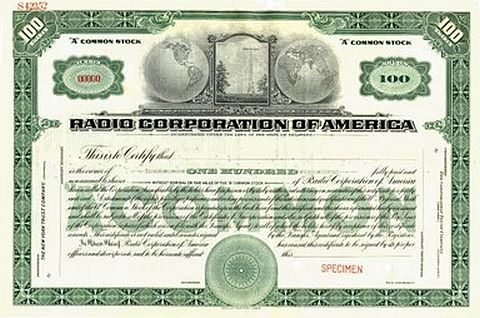
AS us older folks like to enjoy when the war is basically at intermission time, there really isn’t any point in paying attention to the dog day of summer sports, and markets are in the midst of reporting time where the pump monkeys are going to paint everything with rainbows and unicorns, sometimes watching a documentary or a movie is in order.
One of the comments in the ‘talkie’ I was watching referred to an individual issue that rose 10,000% and as some considered it, the modern AI or internet of its time. Of course I am referring to RCA, and often quoted example of historical insanity in markets similar to the .com bust and other manias in US history. I can not even tell everyone how many times I have posted this historical chart of Radio Corporation of America below.

But did I ever go into the happy ending for this equity with all of the sadness which occurred before its demise in 1985?
After the crash in 1929, RCA was one of the survivors despite a 98% drop in price, but barely. When World War II was over it was positioned to transition from a military supplier back to consumer goods and did quite well with radio and soon after television technology where it flourished in the postwar era. Unfortunately, the company stagnated after the 1962 Flash Crash, but rallied until the secular bear market began just after 1967. So what did RCA do when innovation hit the wall and its equity performance began to deteriorate?
From Fineon‘s article, RCA and the Roaring Twenties in November of 2023:
Other technology companies succeeded where RCA failed. RCA was unable to compete with IBM in the production of computers. During the 1960s and 1970s, RCA became bought Hertz (rental cars), Banquet (frozen foods), Coronet (carpeting), Random House (publishing) and Gibson (greeting cards) among other companies, but none of them brought the success RCA was looking for. Television and broadcasting were RCA’s strengths, and the company was unable to develop any other lines of business. The fact that RCA could only expand by buying other companies’ successful businesses says everything about the company in its last two decades.
Think about. One of the leading tech companies for almost half a century ended up buying a rental car company, Banquet frozen foods, a carpet manufacturer, book publishing company, and a greeting cards company. All businesses totally unrelated to their core technological founding but sufficient to make the company a conglomerate that could survive market downturns to some degree.
To highlight the insanity, this quote from a 1969 New York Times article about the acquisition of Banquet should be something my readers retain for the immediate future:
Asked why RCA was entering this new field, a spokesman for the company said that frozen prepared foods is a “dynamic rapid-growth industry in the service field which is in line with RCA activities in the service area.’ In that area, RCA is engaged in car rental, television, business and industrial equipment and military installations.
In other words, they could not compete so they used their cash to buy into other commercial ventures. When General Electric purchased RCA in 1985 it was not to merge their technological innovation into their own corporation, they only wanted the NBC/Universal aspects of the business. Everything else was either spun off our wound down, like RCA.
So what does this have to do with the modern era of financial engineering and wild wild west equity markets?
How about this statement:
A 10,000% increase is for pikers.

It was a dead money company for years until the GFC and into 2020 when the stock began it’s over 400,000% ascent. If anyone thinks this is sustainable, please, seek professional help. Keep in mind that a standard run of the mill Fibonacci correction of 38.2% would be normal for markets, tragic for the political elites.
So when one sees NVDA buying up Applebees or Beyond Meat we all know what that means once and for all. The 1970s secular bear from hell has returned with a vengeance.
YMMV