Sometimes one has to stand out from the crowd and predict the least likely case to become the most shocking outcome.
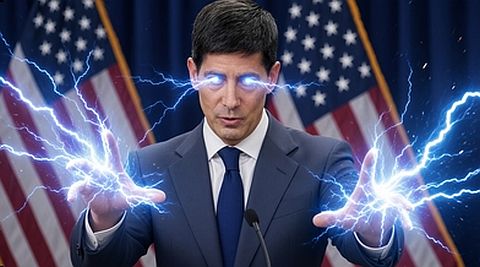
The groupthink presented by many on Wall Street and the nonstop pump and dump financial media is that a quiet and conservative newly selected Federal Reserve Chairman would never grab the paddles and shock the financial markets. Unfortunately for Chair Warsh, the economy is showing cracks as the lowest tier of America’s economic caste continue to struggle some 5 years after the pandemic and the long proclaimed concerns about wealth inequality, a century-plus discussion every capitalist economy endures, has now become a political and economic concern for the financial system.
Although Paul Volcker was the first Federal Reserve Chairman to speak at the Kansas City Federal Reserve Bank’s Jackson Hole symposium, it was Alan Greenspan, Warsh’s pseudo-hero, that regularized the practice beginning in 1989. Since that time, Fed Chairs have spent their moment in the sun there with speeches and moments fluctuating between stunning policy revelations or blunders to plain vanilla academic concerns about economic theory.
But why would Kevin Warsh, in what could be considered his first major solo appearance, want to shock the markets, potentially triggering a short term adverse bond market reaction?
Despite popular belief the Federal Reserve operates in a political vacuum, there is sufficient evidence that the economic pain of the population does filter through the noise to the Eccles Building. That can be best demonstrated from this portion of Danielle DiMartino Booth’s book Fed Up on page 77 and 78 with this excerpt about a FOMC meeting on June 30, 2005:
(Richard) Fisher described “a noticeable dissonance” between the staff’s economic reports and the “tenor of the discussion” around the FOMC table. in the previous few months. Fisher’s extensive contacts and experience were telling him something was amiss in the economy. He had real problems with the Fed’s designated measure of inflation, “core” personal consumption expenditure (PCE) which ignores the prices of food and energy and thus does not reflect inflation’s true level.
This excerpt just further highlights the issues that the Fed’s economic staff has had measuring inflation since the late 1980’s and determining a potential path of operations to reduce or influence future trends in prices. So what we have been witnessing with this embedded, compounding, and continuous inflationary trend since Jay Powell’s horrific ZIRPification of the Fed Funds rate in 2020 is not all that shocking.
Bringing this discussion full circle to Chair Warsh means the new Fed Chair does not have the luxury of waiting on a “task force” to provide inflation measurement options of the current situation. For over five years now, the Fed has misread the inflationary tea leaves and over or under reacted to data which the average American has been screaming bloody murder about since the Trump-Biden fiscal explosion in combination with the Fed’s policy of QE and ZIRP in March of 2020.
The Atlanta Federal Reserve Bank publishes an Underlying Inflation Dashboard to provide a snapshot which truly highlights Warsh’s dilemma:

None of the indicators, including the theoretical new shift potentially to FRB Dallas Trimmed-Mean PCE, reflect a 2.0% or lower inflation rate.
This consideration must be taken into account when reflecting on the options presented to FOMC Chairman Warsh and the words he elects to use tomorrow morning. In this author’s opinion, the speech will not direct nor call for an increase in the Fed Funds rate. But the tone and inference that more action will be required to contain and slay the inflationary dragon is a probable outcome that can not be discounted by anyone who has watched Fed speeches and policies for the past four decades.
This author looks for a Greenspan salad of complex theory with a bittersweet dressing of sour notes designed to warn markets of a much more stringent FOMC policy approach to stem the trend and decelerate PCE plus other measures faster and closer to the 2.0% inflation target.
The good news for bond market?
FOMC chairs almost always serve desert after their word salads thus the caveat of “if necessary” might be the refrain of the day to prevent an outright liquidation of the long end of the curve as the Jackson Hole meeting concludes.